A backyard usually looks its best right around dusk. The patio is cleaned off, the landscaping softens the edges of the yard, and then the sun drops – and half the space disappears. That is why smart backyard lighting ideas matter so much. Good lighting helps your yard stay useful after dark, but it also makes the whole property feel safer, cleaner, and more finished.
In the Chicago suburbs, this matters even more because we spend a lot of the year dealing with early sunsets, cloudy evenings, and long stretches when outdoor light disappears fast. If you want to enjoy your patio, make the yard easier to walk through, or simply make the house look better from the street, lighting can do a lot of work without tearing up the whole landscape.
What good backyard lighting should do
A lot of homeowners start by thinking about fixtures. That makes sense, but it is not really the first question. The first question is what you want the yard to do at night.
A good lighting plan usually does three things at once. It helps people move around safely, it highlights the parts of the yard worth seeing, and it makes the space feel comfortable instead of harsh or overly bright. This is where many homeowners run into trouble. They add a few random solar lights, maybe one flood light on the garage, and the result feels uneven. Some areas are too dark, others are too bright, and the yard still does not feel inviting.
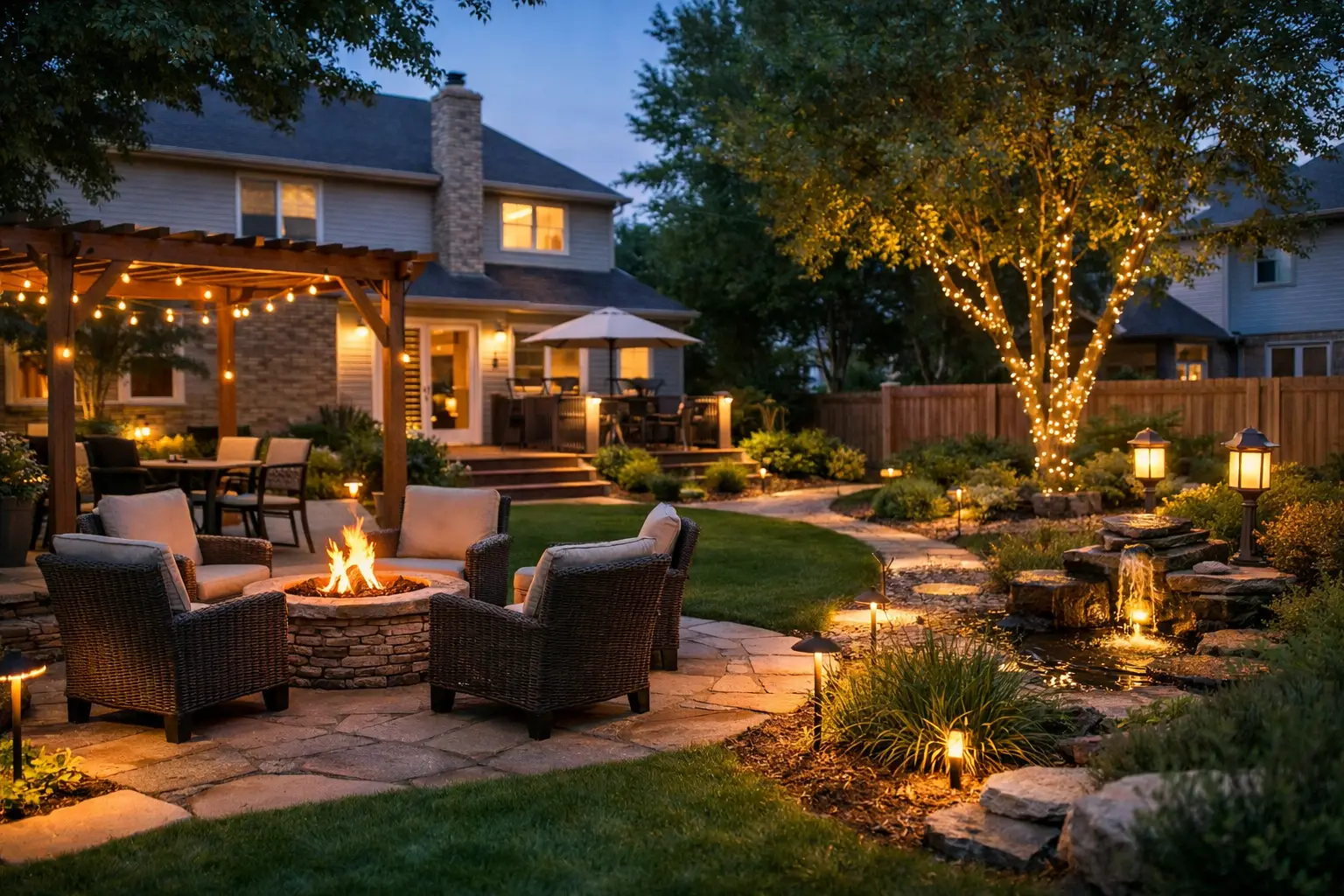
The best setups are layered. You might light a walkway low to the ground, add a softer glow near a seating area, and then use focused lighting on a tree, pergola, or stone wall. That gives the yard depth instead of making it look flat.
Backyard lighting ideas for the areas you use most
Light the patio first
If you have a patio, start there. Most backyards revolve around that space, whether it is used for dinner, watching the kids play, or sitting outside on a summer night. Patio lighting should be bright enough to see people and steps clearly, but not so strong that it feels like a parking lot.
Warm lighting usually works best here. Under-cap lighting on seat walls, downlighting on a pergola, or subtle fixtures around the edge of the patio can make the area feel finished without being glaring. If your patio connects to the back door, it helps to make that transition easy to see. In Illinois, wet leaves, frost, and uneven surfaces can all become tripping hazards when the light is poor.
Make walkways easier to follow
Path lights are one of the most practical backyard lighting ideas because they solve a real problem right away. They guide people where to walk and help define the shape of the yard after dark.
That said, more is not always better. A common mistake is lining every foot of a walkway with lights. That can look cluttered and overly busy. Spacing matters. You want enough light to show the route, but not so many fixtures that the yard starts to feel crowded. A cleaner layout often gives a better result.
Add steps and grade changes to the plan
Backyards in the western suburbs are not always perfectly flat. Some have retaining walls, sunken patios, raised decks, or a couple of steps that are easy to miss at night. Those areas deserve extra attention.
This is where low-mounted step lights or under-cap lighting can do a lot of good. They help people move safely without throwing light into their eyes. It is a simple upgrade, but one that makes a yard feel much more thought-out.
Use lighting to show off the best parts of the yard
Highlight trees and larger plantings
If you have a mature tree, ornamental tree, or layered landscape bed, lighting can make it a feature instead of letting it vanish after sunset. Uplighting at the base of a tree can show off branching structure and texture. A well-placed light near shrubs or grasses can add depth and shadow that looks great from the patio and from inside the house.
It depends on the plant material, though. Not every shrub needs a spotlight. Some yards look better with just a few focal points. The goal is to create interest, not light every plant in the bed.
Bring fences, pergolas, and walls into the design
A fence line, pergola, or retaining wall can look heavy and dark at night if it is left unlit. A little soft lighting can help define those edges and make the yard feel bigger.
Pergolas are especially good for this because they add structure overhead. Downlighting mounted within the frame can create a comfortable glow over a seating area. Fences and walls often do better with indirect light. You want to reveal texture and shape, not blast the surface with brightness.
Make water and stone features stand out
If your yard includes a paver patio, seat wall, decorative boulders, or another hardscape feature, lighting can help those materials show better at night. Stone and textured surfaces catch light in a way flat siding does not. Even a modest fixture in the right spot can make the entire yard feel more polished.
This is one reason lighting works so well as part of a larger outdoor improvement plan. A good landscape should look nice, but it also needs to work. Lighting helps you get more value out of the features you already paid for.
Backyard lighting ideas that improve comfort and security
Keep dark corners from feeling forgotten
Not every part of the yard needs to be a focal point, but truly dark corners can make the property feel unfinished or uncomfortable. A side yard gate, the run between the garage and house, or the area near the back steps often needs just enough light to remove that dark gap.
This does not mean adding a giant flood light. In most cases, softer and more targeted lighting does a better job. You want visibility and peace of mind without creating glare for your family or your neighbors.
Use warm light, not harsh light
One of the easiest ways to get backyard lighting wrong is to make it too blue or too bright. Homeowners often think brighter means better, but that usually creates a colder, less relaxing space.
Warm light tends to feel more natural in residential settings. It works well with brick, stone, wood, and most common materials around Illinois homes. It also feels better when you are sitting outside for a while. If you are trying to create a backyard you actually want to use, comfort matters just as much as visibility.
Plan for Illinois weather and real maintenance
A lighting setup has to hold up through more than one nice July evening. In Chicagoland, fixtures deal with rain, heat, snow, ice, fallen leaves, and freeze-thaw cycles. That is why installation quality matters.
Wiring, placement, and fixture choice all affect how well the system holds up over time. Cheap fixtures or poor placement can lead to problems fast. Lights get knocked out by edging and mowing, hidden by overgrown plants, or installed where water sits too long. You do not want a lighting plan that looks good for one season and becomes a maintenance headache after that.
This is also why solar lights can be hit or miss. They seem easy, and sometimes they are fine for a short path or a temporary accent. But in shaded yards, cloudy weeks, or during shorter winter days, performance can be inconsistent. For homeowners who want reliable results, a professionally planned low-voltage system usually gives a cleaner and more dependable outcome.
Think in layers, not one fixture type
The strongest backyard lighting ideas usually mix a few techniques instead of relying on one. A patio might need overhead or structural light, a walkway may need low path lighting, and a tree might need one accent light to anchor the yard visually.
That layered approach keeps the space balanced. It also lets you control where attention goes. If everything is equally bright, nothing stands out. If the lighting is planned with purpose, the yard feels calmer and more usable.
For many Chicagoland homeowners, the right plan is not the biggest one. It is the one that fits how the yard is used. A family with kids and a busy patio will need something different from a homeowner who wants to highlight mature landscaping and improve evening curb appeal. That is why cookie-cutter lighting plans usually fall short.
When to bring in help with backyard lighting ideas
If you are only trying to brighten one small area, a basic fix may be enough. But if you want the yard to look finished, feel safe, and work well from the house to the fence line, it helps to plan the whole picture.
Lighting touches landscaping, hardscaping, drainage, mowing patterns, and how people actually move through the property. That is where many homeowners benefit from working with a local contractor who understands more than just the fixture itself. In Illinois, this matters because the yard has to function through changing seasons, not just during peak summer weather.
The best outdoor lighting does not call attention to itself first. It makes the yard easier to use, nicer to look at, and more enjoyable at the end of the day. When it is done right, you stop noticing the darkness and start using the space the way you wanted to all along.