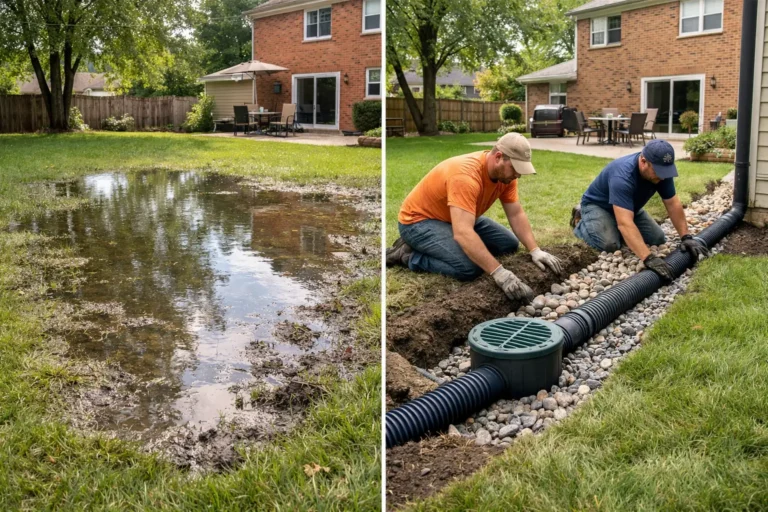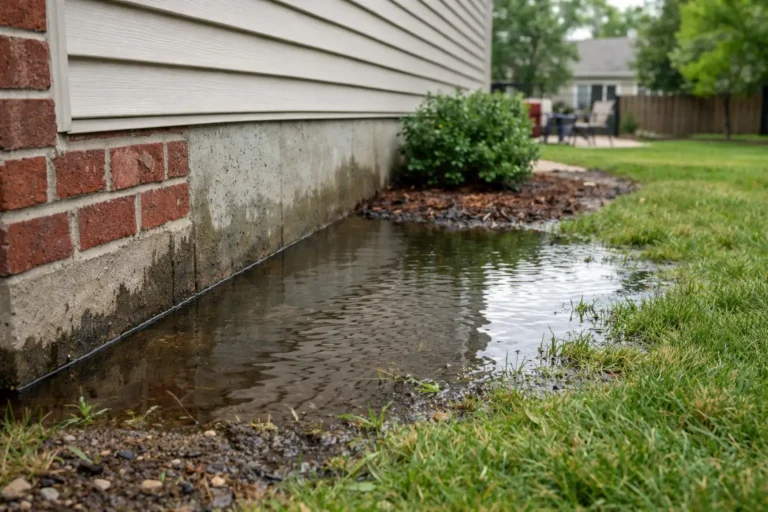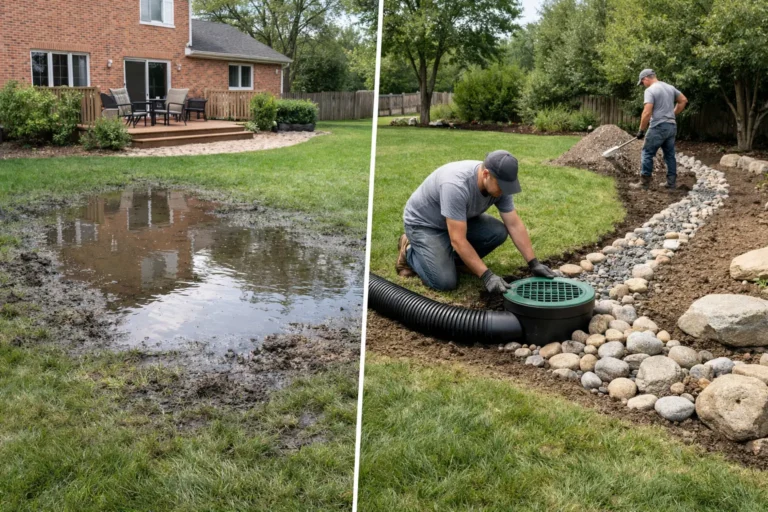
If you have water sitting in the yard a day or two after rain, the french drain vs dry well question is not just a landscaping detail. It usually means your property is telling you something. In the Chicago suburbs, that might be heavy clay soil, a low spot in the lawn, downspouts dumping too much water in one area, or grading that pushes water toward the house. You do not want water sitting near your foundation, and you also do not want a backyard that stays muddy every time we get a good Illinois storm.
The tricky part is that a french drain and a dry well solve different problems. Homeowners often hear both terms and assume they are interchangeable. They are not. Here’s what to look for so you can understand which option actually fits your yard.
French drain vs dry well: the basic difference
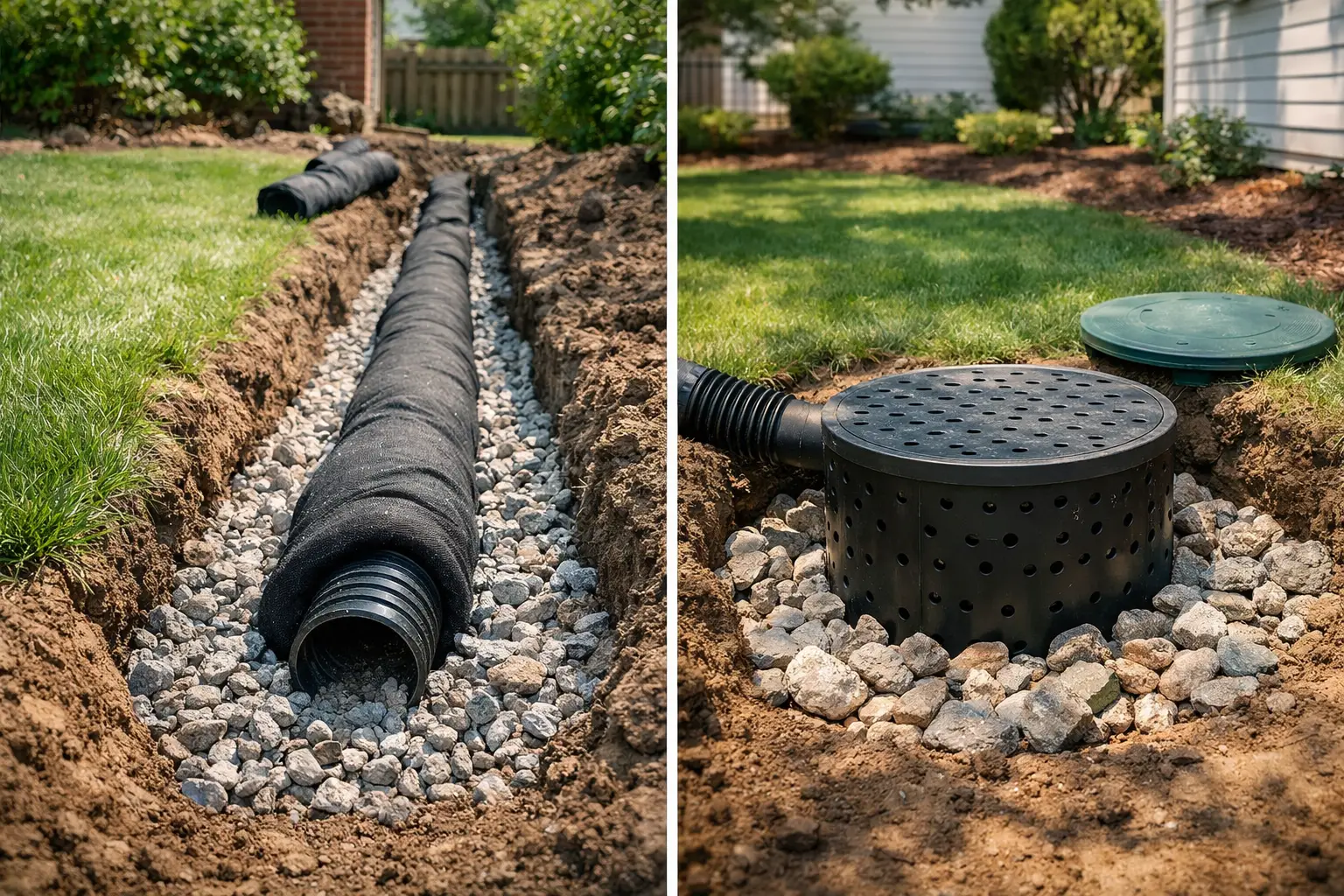
A french drain is designed to collect moving or spreading water and carry it away. It is usually a gravel-filled trench with a perforated pipe inside. Water enters the trench, flows into the pipe, and gets redirected to a safer outlet area.
A dry well is built to collect a concentrated amount of water and let it slowly soak into the ground. Think of it like an underground holding area for runoff. It is often connected to a downspout or drain line where water gathers in one place.
That simple difference matters a lot. If water is traveling across your yard or pooling over a wide area, a french drain is often the better tool. If one gutter downspout is dumping water in the same spot over and over, a dry well may make more sense.
When a french drain makes more sense
A french drain works best when the problem is spread out, not just concentrated at one point. You might have a side yard that stays wet, a low strip along the foundation, or water creeping across the lawn after every storm. In those cases, the goal is to intercept the water and move it before it becomes a bigger issue.
This is where many homeowners run into trouble. They see standing water and assume they just need a place for it to go. But if the water keeps feeding into that area from uphill grading or surrounding soil, a simple collection pit will not solve the root problem. The water needs to be captured and redirected.
In Illinois, this matters because many yards in Chicagoland have dense clay soil. Clay does not drain quickly. So if water is already slow to soak in, asking it to disappear in one underground chamber is not always realistic. A french drain can help by giving that water a path out instead of asking the soil to absorb everything at once.
French drains are often a smart fit for:
- soggy lawn sections
- water near a foundation
- runoff moving down a side yard
- landscape beds that stay too wet
- areas where grading alone is not enough
That does not mean every wet yard needs a french drain. The layout still has to make sense. There needs to be a workable path for the pipe and a proper discharge point.
When a dry well is the better choice
A dry well is usually the better answer when too much water is collecting at one source. The most common example is a roof downspout. If a large section of roof is dumping water into one corner of the yard, that area can get overwhelmed fast.
A dry well takes that concentrated runoff and gives it a place to collect underground, then slowly release into the surrounding soil. It can be useful where you do not have an easy place to daylight a pipe or send water farther away.
That said, dry wells are not magic. In heavy clay soil, they can struggle if they are undersized or installed in a spot where the ground already stays saturated. If the soil cannot absorb the water fast enough, the system backs up and you are right back where you started.
For many Chicagoland homeowners, a dry well works best when the drainage issue is fairly contained and the surrounding conditions support infiltration. It is often used for downspouts, sump pump discharge planning in the right setup, or small areas where runoff is not constant across the whole yard.
French drain vs dry well in Illinois soil
If I were explaining this at a yard walkthrough, this is the part I would slow down on. Soil and grading matter just as much as the drainage product itself.
A lot of homes in the western suburbs and across Chicagoland sit on clay-heavy soil. That means water tends to move slowly downward and can also spread sideways through the top layers. So even a well-built dry well may not perform the way it would in sandy soil.
A french drain often has the advantage in these conditions because it does not rely only on absorption. It gives water a route to travel. But even then, the design matters. If the pipe has nowhere useful to discharge, the system can underperform.
This is why good drainage work starts with diagnosing the property, not picking a product off a list. You have to look at roof runoff, slope, low spots, soil type, hard surfaces, and where the water can realistically go.
The trade-offs homeowners should know
Both systems can work well. Both can also disappoint if they are used for the wrong problem.
A french drain is great at moving water, but it usually requires more trenching and careful planning. The route matters. The outlet matters. The pitch of the pipe matters. If it is installed too shallow, too flat, or without enough stone and fabric protection, it can clog or fail to keep up.
A dry well can be less disruptive in some situations because it is more contained. But it depends heavily on the soil’s ability to absorb water over time. In a wet Illinois spring, or during stretches of repeated storms, that can be a real limitation.
There is also the long-term side to think about. Tree roots, sediment, roof debris, and poor downspout management can affect either type of system. A good landscape should look nice, but it also needs to work. That means drainage should be built with maintenance and real yard conditions in mind, not just hidden underground and forgotten.
Sometimes the right answer is both
This is probably the most overlooked part of the french drain vs dry well conversation. Sometimes it is not either-or.
On some properties, a french drain handles the broad wet area while a dry well manages runoff from a specific source, like one roof line or patio drain. On other homes, downspouts are tied into a larger drainage system that moves water away from the house before it reaches a collection area.
That kind of combined approach is common when yards have more than one issue going on at once. A homeowner may have soggy turf in the backyard, water near the foundation on one side, and one overflowing downspout near a patio. Trying to solve all of that with one drainage feature usually leaves part of the problem behind.
What to look for in your own yard
You do not need to diagnose the whole drainage plan yourself, but it helps to notice patterns. Ask where the water starts, where it travels, and how long it stays. Is it coming off the roof? Is it moving downhill from a neighbor’s yard? Is it collecting in a low area with nowhere to go?
Also pay attention to timing. If the area floods during the storm and then drains quickly, that points to one kind of issue. If it stays soft and muddy for days, that points to another. In Naperville-area homes, Downers Grove backyards, and many other suburban properties, those little clues say a lot.
If the wet area is close to your house, do not wait too long. Foundation issues, mulch washout, turf damage, slippery walkways, and mosquito-friendly puddles tend to get worse, not better.
Choosing the right drainage fix
When homeowners ask whether they need a french drain or a dry well, the honest answer is: it depends on how the water behaves on that property. A french drain is usually the better fit for moving water away from broad wet areas. A dry well is usually better for collecting water from one concentrated source and letting it soak in over time.
In Illinois, the best solution often comes down to a few local realities – clay soil, strong storms, freeze-thaw cycles, and neighborhood grading that is not always ideal. That is why the smartest move is to look at the full picture instead of chasing a one-size-fits-all fix.
If your yard is staying wet, your downspouts are overwhelming one corner, or water keeps showing up where it should not, the right drainage system can make the whole property work better. You should be able to use your yard without tiptoeing around mud or worrying every time rain is in the forecast.